MENU
The newest post and image entries are on top of the page. Scroll from the bottom upwards to follow the flow status timeline of the Ruaha River per location
Last Updated 3 weeks ago
Great Ruaha River — Zero Flow at ParkHQ: machine date and human confirmation
Update: 29 October 2026
Satellite monitoring identified 29 September 2026 as the first machine zero-flow date at ParkHQ/Msembe Bridge. This machine date is based on repeated analysis of upstream, Bridge and downstream satellite observations showing that continuous surface-water flow had ceased and that only disconnected standing pools remained.
A few days later, 4 October 2026 was adopted as the human-supervised confirmation date used on this website. This human date does not represent a different river event; rather, it is the supervised interpretation date retained for public communication after reviewing the available evidence.
As of 29 October 2026, this means:
- 30 days since machine ZFO-ParkHQ (29 Sep 2026)
- 25 days since human confirmation (4 Oct 2026)
Why can machine and human dates differ?
The two dates reflect different roles in the interpretation process:
- Machine ZFO-ParkHQ date
The satellite-based date at which the monitoring system identifies loss of continuous surface flow. - Human confirmation date
The later supervised date used for communication after reviewing image quality, residual pools, and consistency across methods.
In other words, the machine helps detect the likely zero-flow date, while the human supervisor checks and confirms how that evidence should be reported.
What does the 2026 evidence show?
In 2026, the three main source series all supported the late-September transition:
- Upstream reached near-zero first and acts mainly as an early-warning indicator.
- Bridge still retained standing pools, so zero flow does not mean the riverbed becomes visually empty.
- Downstream independently supported the interpretation that only shrinking, disconnected pools remained. But the decline of the pools is less rapid than the decline of the flowing river channel, explaining the reduced slope of the decline during the zero flow period of disconnected pools.
This distinction is important: zero flow at ParkHQ means loss of connected surface flow, not disappearance of every isolated pool. A schematic representation of the decline pattern is shown in the first image below. The shrinking river channel stops flowing as all surface flow has dried and only the disconnected pools in the riverbed remain. With no more supply the pools will also shrink but less fast as a drying river.
Historical context
The same relationship between machine evidence and human supervision also appears in earlier years. In some years the machine candidate appears earlier than the historical human reference; in other years clouds, short events, or residual pools make a clean machine decision difficult. This is why the process is not a one-click result, but a supervised interpretation based on several imperfect data sources.
A worked historical example is shown below for 2026, where the machine date and the human upstream reference can be compared directly.
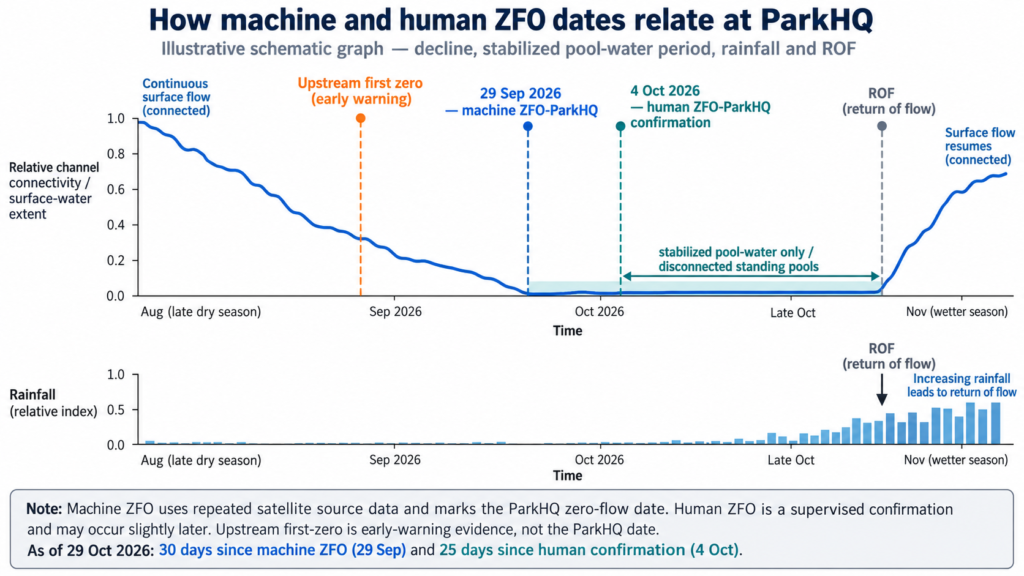
The machine ZFO-ParkHQ date marks the point when continuous surface flow is judged to have ceased. The later human confirmation date is the supervised reporting date used on the website. Upstream first-zero is early-warning evidence only and should not be confused with the ParkHQ date itself.
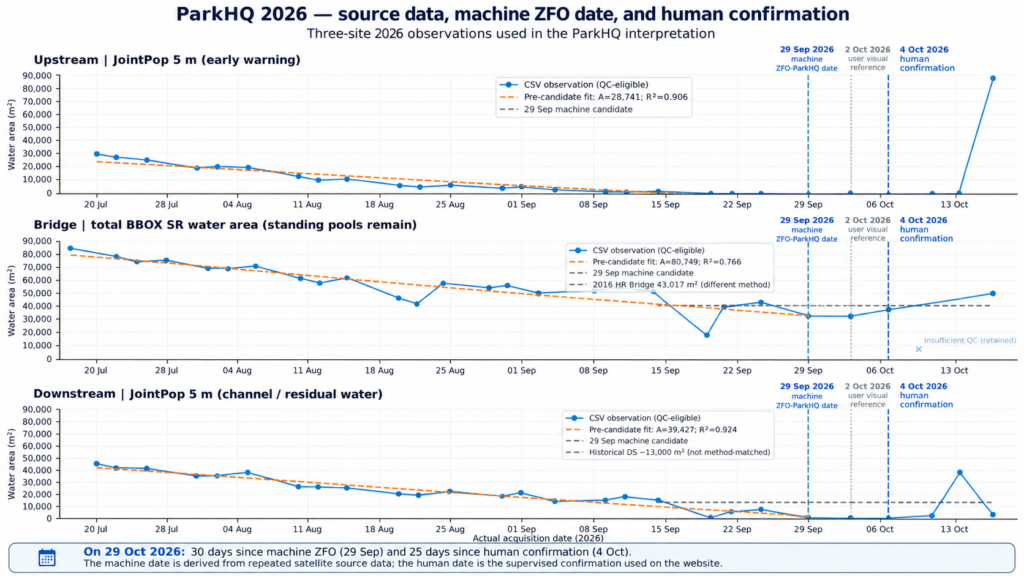
The upstream series provides early warning, while Bridge and downstream observations help assess whether connected flow has ended and only residual pools remain. The figure shows the machine ZFO-ParkHQ date (29 Sep 2026) and the supervised human confirmation date (4 Oct 2026).
Great Ruaha River — Machine Zero-Flow Confirmation | 4 October 2026
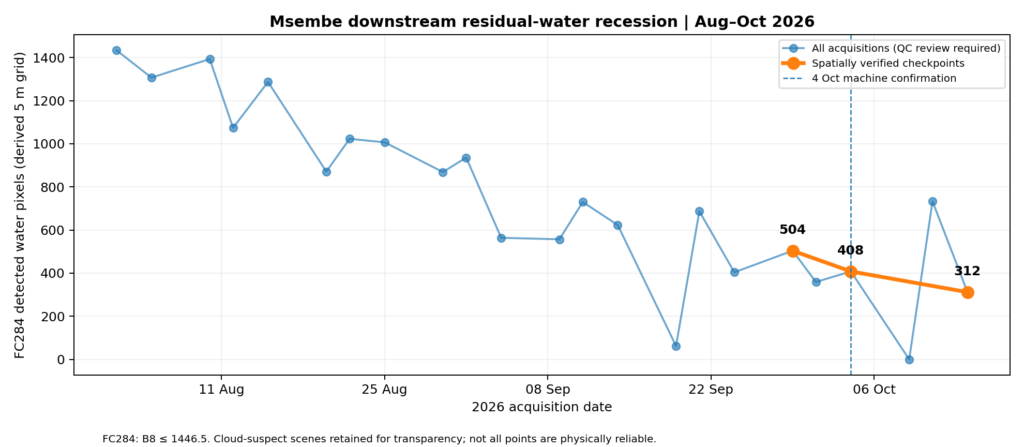
Satellite monitoring identifies 29 September 2026 as the first combined zero-flow candidate at ParkHQ/Msembe Bridge. Repeated observations on 4 October 2026 support machine confirmation that continuous surface-water flow had ceased.
Independent downstream monitoring supports this decision. Between 29 September and 14 October, the conservative Sentinel-2 water detector recorded a reduction from 504 to 312 water pixels (−38%). Spatial comparison shows that the remaining detected water occupies only locations already classified as water on 29 September, consistent with shrinking, disconnected pools rather than renewed through-flow.
Official machine ZFO confirmation date: 4 October 2026.
This is a satellite-based machine determination; field verification remains outstanding.
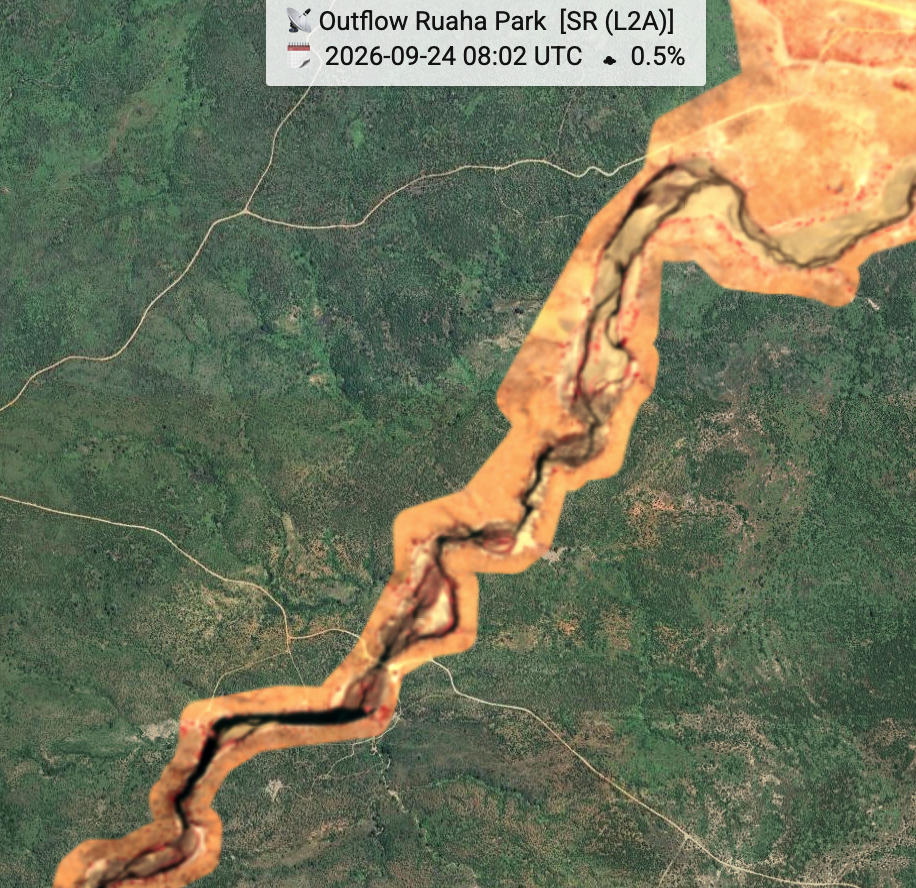
On September 24, 2026 sustained flow at Ruaha Park HQ
Although declining conditions have been system-assessed since 4 September 2026, observations published by local contributors continued to show sustained flow on 24 September. “System-assessed” means that the hydrological state was derived by the Ruaha Flow Monitoring System from satellite observations and governed processing rules, rather than reported directly by a person.